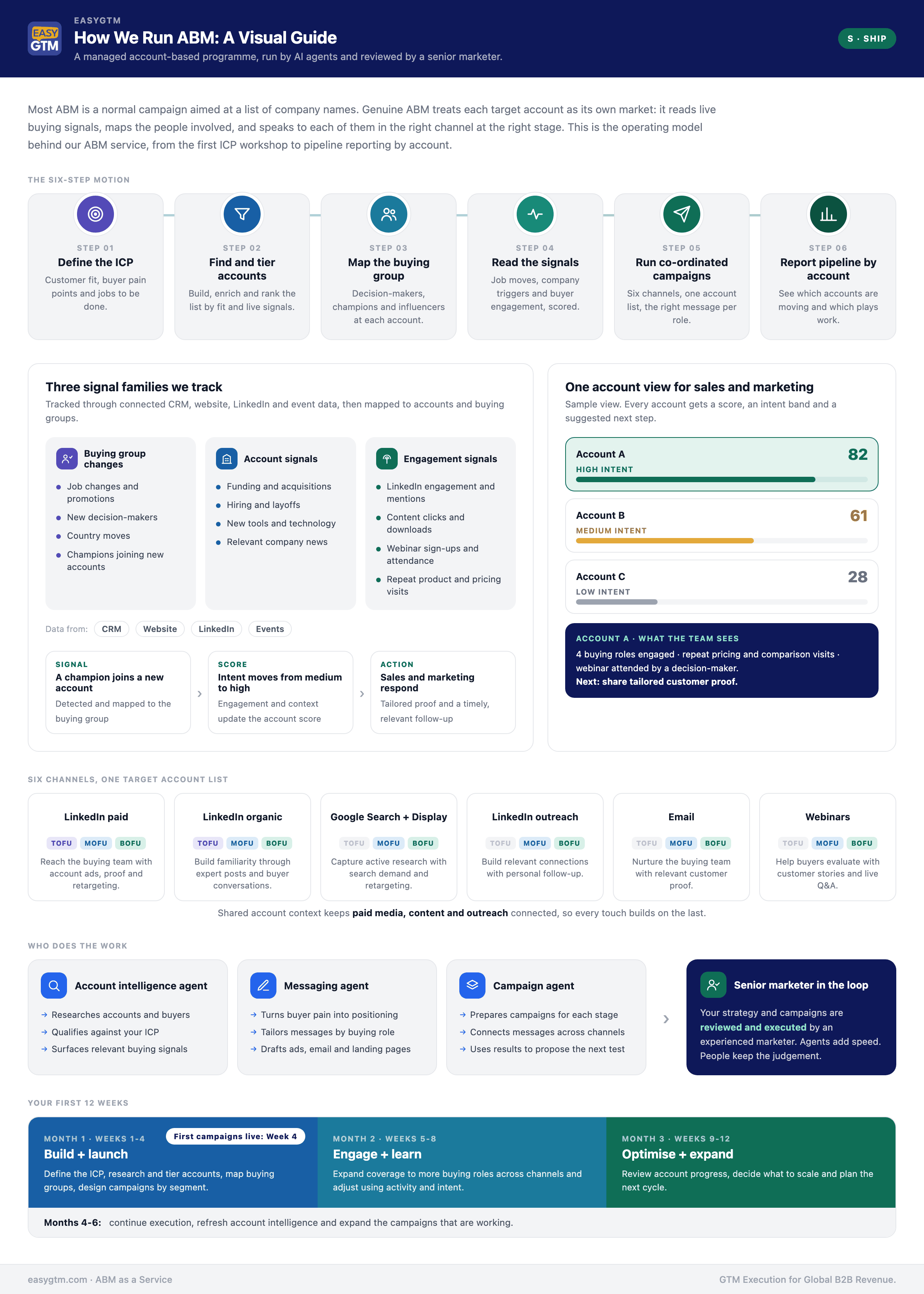
Account-based marketing (ABM) is a go-to-market approach that treats each target account as its own market, with messaging and campaigns built for the specific buying group at that account. EasyGTM runs it as a six-step motion: define the ICP, find and tier the accounts, map the buying group, read the buying signals, run co-ordinated campaigns, and report pipeline by account. The guide above shows the full model.
Most ABM falls short of this. The LinkedIn ad reaches the right company but not the right person, the email carries a first name and nothing else, and sales never sees what marketing is doing. The model below is one programme, run from one account view.
The six steps at a glance
- Define the ICP. Customer fit, buyer pain points and jobs to be done.
- Find and tier the accounts. Build, enrich and rank the list by fit and live signals.
- Map the buying group. Decision-makers, champions and influencers at each account.
- Read the buying signals. Job moves, company triggers and buyer engagement, rolled into an account score.
- Run co-ordinated campaigns. LinkedIn paid and organic, Google, outreach, email and webinars, with the right message for each role.
- Report pipeline by account. See which accounts are moving and which plays are working.
The six-step motion
It starts with the foundation. We define the ICP (customer fit, buyer pain points and the jobs the buyer is trying to get done), then build, enrich and tier the account list against it. For each account we map the buying group: the decision-makers, champions and influencers whose views shape the purchase. From there, the programme runs on live signals, co-ordinated campaigns, and reporting that connects account activity to pipeline.
Signals decide where effort goes
We track three families of signal through connected CRM, website, LinkedIn and event data. Changes in the buying group, such as a promotion or a champion moving to a new company, show who matters. Account signals, such as funding, hiring or a new tool in the stack, show when an account is likely to be in motion. Engagement signals, such as repeat pricing visits or a decision-maker attending a webinar, show who is already paying attention. Together they feed a single account score, so sales and marketing look at the same view and agree on what happens next.
One list, six channels
LinkedIn paid and organic, Google search and display, LinkedIn outreach, email and webinars all work from the same target account list. Each carries the message that suits the buyer’s role and stage, from awareness through comparison to the confidence to act. Shared account context is what stops these from becoming six separate campaigns.
Agents for speed, people for judgement
Three AI agents do the heavy lifting. One researches accounts and qualifies them against the ICP, one tailors messaging by buying role, and one prepares campaigns for each stage and proposes the next test from the results. A senior marketer reviews and executes every strategy and campaign. The agents make the programme faster and more specific. They do not decide what is credible to a buyer. That stays with an experienced person.
The first twelve weeks
Month one is build and launch, with the first campaigns live in week four. Month two is engage and learn: coverage expands to more buying roles and campaigns adjust to activity and intent. Month three is optimise and expand: review account progress, decide what to scale, and plan the next cycle. From month four, the work continues, with account intelligence refreshed and the winning campaigns extended.
For the thinking behind the model, read ABM: What It Looks Like When It Actually Works. To see how this would work for your target accounts, read about our ABM service or book a 30-minute E-A-S-Y Audit.