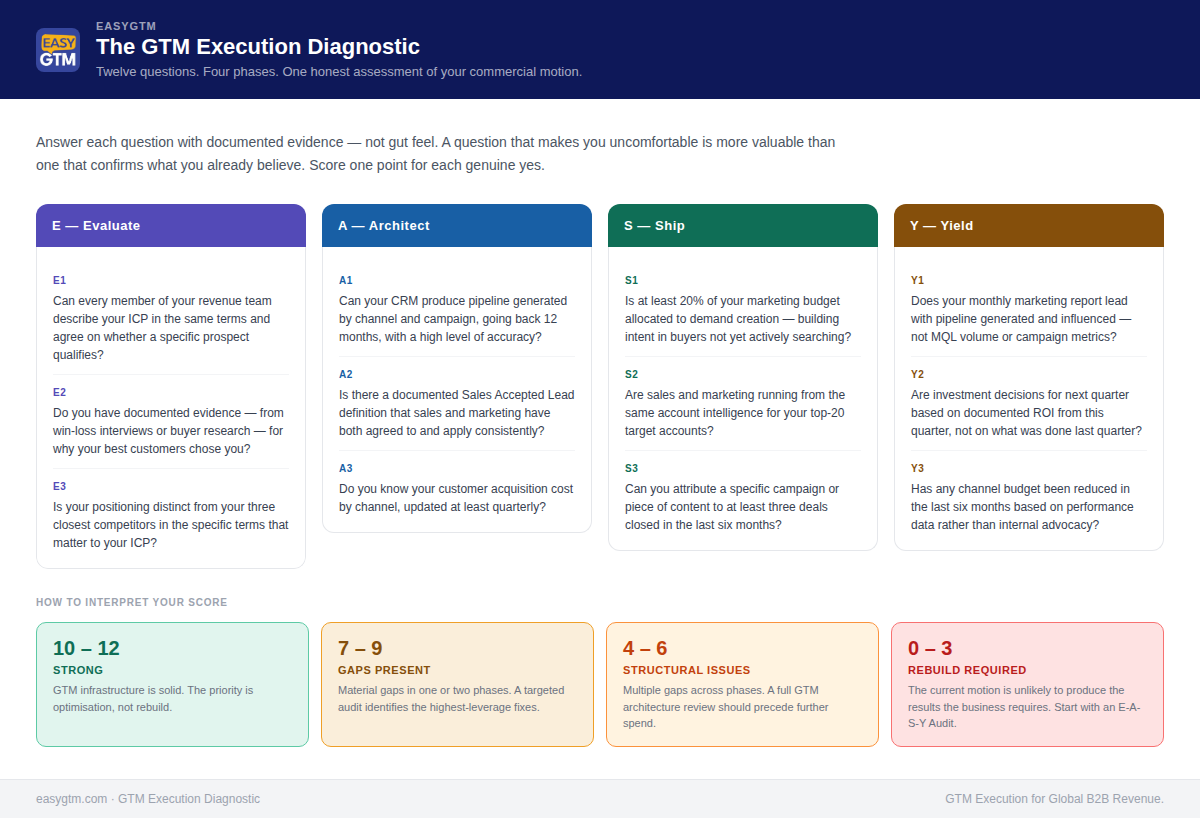
The GTM execution diagnostic is a structured self-assessment tool for revenue leaders who want to identify where their commercial motion is underperforming before the P&L confirms it. Each question maps to one of the four E-A-S-Y phases and is designed to surface a specific class of structural problem.
Answer honestly. A question that makes you uncomfortable is more valuable than one that confirms what you already believe.
Evaluate
E1. Can every member of your revenue team describe your ICP in the same terms and agree on whether a specific prospect qualifies?
E2. Do you have documented evidence — from win-loss interviews, customer research, or buyer conversations — for why your best customers chose you?
E3. Is your positioning distinct from your three closest competitors, in the specific terms that matter to your ICP?
Architect
A1. Can your CRM produce a report showing pipeline generated by channel and campaign, going back 12 months, with a high level of accuracy?
A2. Is there a documented Sales Accepted Lead definition that sales and marketing have both agreed to and both apply consistently?
A3. Do you know your customer acquisition cost by channel, updated at least quarterly?
Ship
S1. Is at least 20% of your marketing budget allocated to demand creation (building intent in buyers who are not yet searching) rather than demand capture?
S2. Are sales and marketing running from the same account intelligence for your top-20 target accounts?
S3. Can you attribute a specific piece of content or campaign activity to at least three deals closed in the last six months?
Yield
Y1. Does your monthly marketing report lead with pipeline generated and influenced, rather than with MQL volume and campaign metrics?
Y2. Are investment decisions for next quarter based on documented ROI from this quarter, or primarily on what was done last quarter?
Y3. Has any channel budget been reduced in the last six months based on performance data, rather than on an agency’s recommendation or internal advocacy?
How to score the diagnostic
Count the number of questions to which you can answer yes with documented evidence — not gut feel, not a belief that it is probably true, but a specific document or data point that confirms it.
10 to 12: Your GTM infrastructure is strong. The priority is optimisation rather than rebuild.
7 to 9: Material gaps exist in one or two phases. A targeted audit of those phases will identify the highest-leverage fixes.
4 to 6: Multiple structural gaps across phases. A comprehensive GTM architecture review is warranted before increasing spend in any channel.
0 to 3: The current GTM motion is unlikely to produce the commercial results the business requires. A full E-A-S-Y audit should precede any further investment.