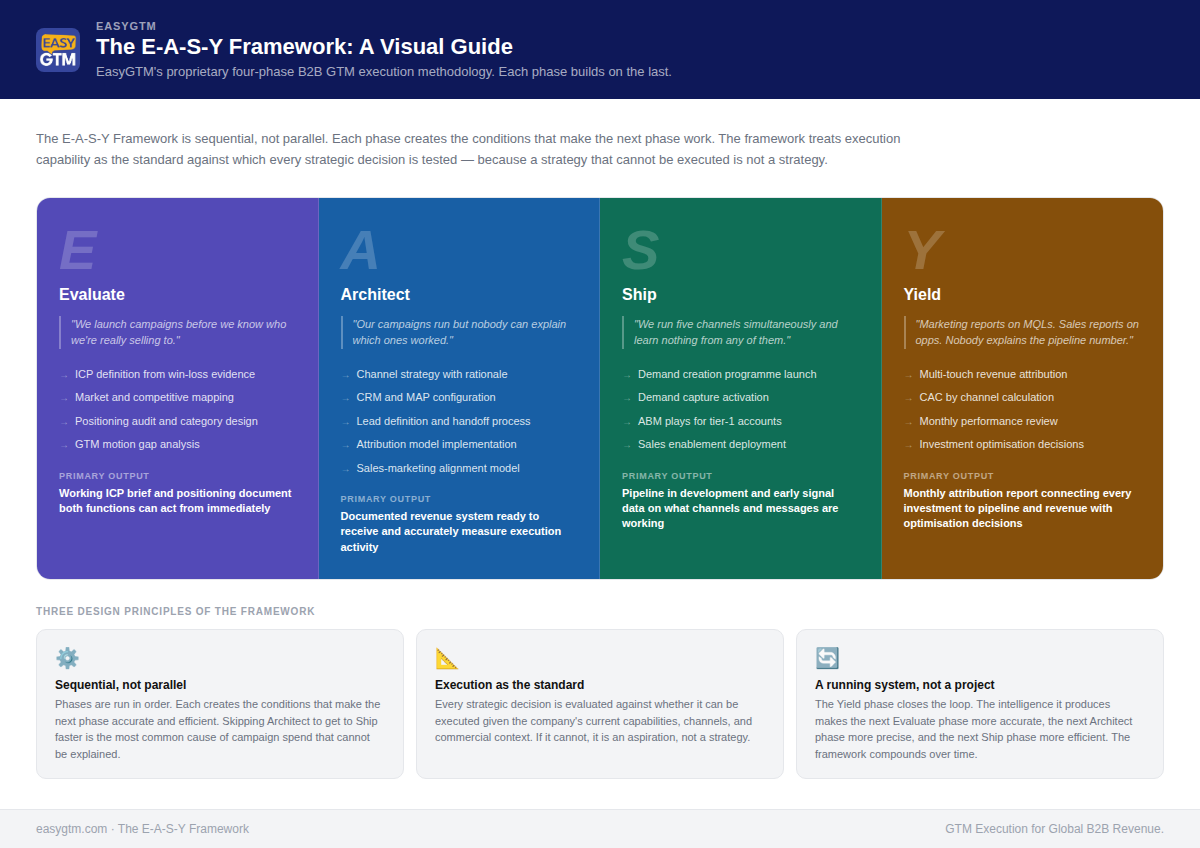
The E-A-S-Y Framework is a four-phase B2B GTM execution methodology designed to close the most consistent failure mode in commercial strategy: the gap between a coherent plan and an executable commercial motion. Each phase has a specific problem it solves, a specific set of activities, and a specific output that serves as the input to the phase that follows.
The framework is sequential rather than parallel. Phases are not run simultaneously. Each phase creates the conditions that make the next phase work. Running Ship before Architect is like launching campaigns into a CRM that is not configured to measure them — the spend occurs, the results are unclear, and the investment cannot be justified to a leadership team that expected a pipeline outcome.
E — Evaluate: clarity before spend
The problem it solves. Most B2B companies spend before they have clarity on who they are selling to, what position they occupy in the market, or where the current commercial motion is underperforming.
The activities. ICP definition using win-loss data and buyer research. Competitive landscape mapping. Positioning audit. GTM motion assessment identifying gaps in capability, infrastructure, and execution.
The output. A working brief containing the ICP definition, positioning statement, competitive context, and a gap analysis that prioritises what needs to be built before the programme can perform.
A — Architect: system before campaigns
The problem it solves. Campaign performance is consistently constrained by the quality of the infrastructure it runs through — CRM configuration, attribution models, lead handoff processes, and channel architecture.
The activities. Channel strategy definition with rationale per channel. CRM and marketing automation configuration. Lead definition and handoff process documentation. Attribution model selection and implementation. Sales and marketing alignment on shared metrics.
The output. A documented revenue system ready to receive and measure the activities that the Ship phase will generate.
S — Ship: launch, test, read signals
The problem it solves. Execution without architecture produces activity that cannot be measured. Architecture without execution produces documentation without commercial results.
The activities. Demand creation programme launch (category-level content and social). Demand capture activation (paid, outbound, intent-targeted). ABM plays for top-priority accounts. Sales enablement deployment.
The output. Pipeline in development. Early signal data on which channels, messages, and account types are responding. Intelligence for the Yield phase.
Y — Yield: revenue, not reports
The problem it solves. Most commercial functions measure activity, not outcome. Budget decisions are made based on what happened rather than what worked.
The activities. Multi-touch revenue attribution. CAC calculation by channel. Monthly commercial performance review. Optimisation decisions for next quarter.
The output. A monthly attribution report connecting every commercial investment to pipeline and revenue. Investment recommendations that both sales and marketing have agreed to, grounded in data.
The E-A-S-Y Framework is the operating model for every EasyGTM engagement. It is not a consulting deliverable — it is a running system that continues to produce commercial intelligence after the initial programme is complete.