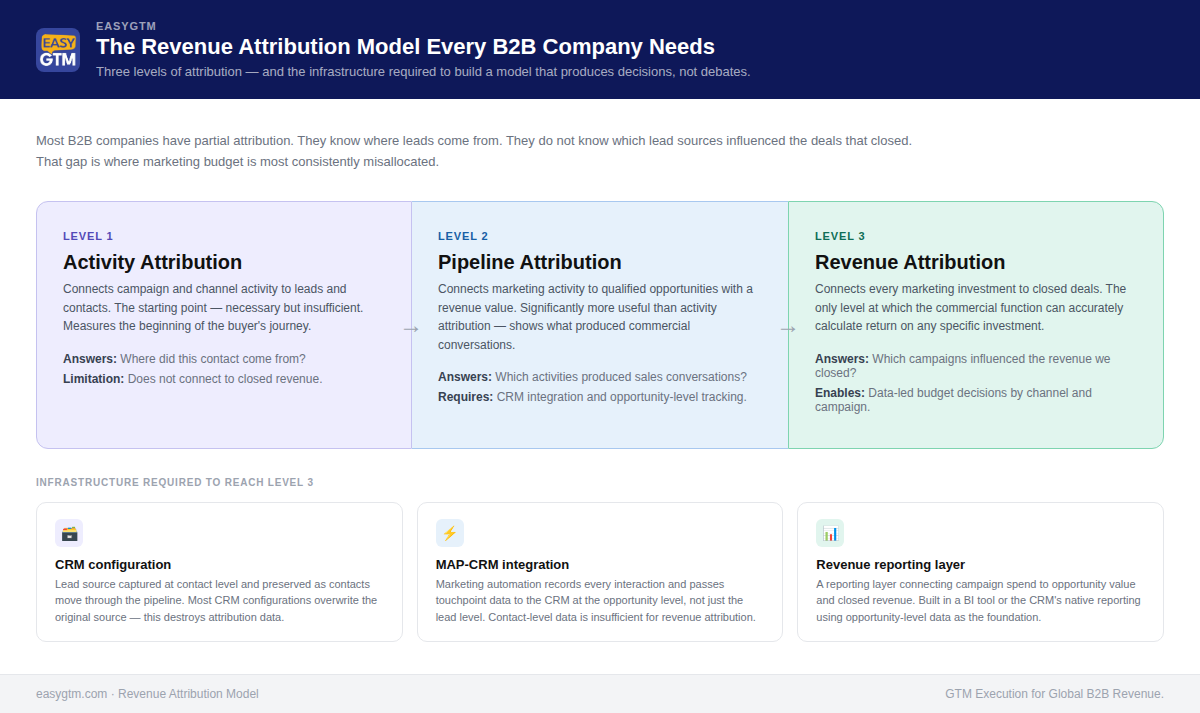
Revenue attribution is the commercial function’s equivalent of financial auditing. Without it, every investment decision in GTM is made on the basis of incomplete information. With it, the commercial function can answer the questions that drive good resource allocation: which channels produce the most pipeline per pound invested, which campaigns influence the deals that close, and where the next pound of marketing budget should go to generate the most commercial return.
Most B2B companies have partial attribution. They know where leads come from. They do not know which of those lead sources influenced deals that closed. The gap between these two data points is where marketing spend is most frequently misallocated.
Why most attribution models are wrong
The two most common attribution models in B2B marketing — first-touch and last-touch — both produce inaccurate answers by design. First-touch gives all credit to the channel where the buyer first engaged, ignoring everything that happened subsequently. Last-touch gives all credit to the final interaction before conversion, ignoring the awareness and consideration activity that created the conditions for that conversion. Both models are simple to implement and both systematically mislead.
For B2B purchases with multiple buying committee members, long evaluation cycles, and often ten or more distinct touchpoints between awareness and close, neither model is close to accurate.
The multi-touch model
A multi-touch attribution model distributes credit across the interactions that occur throughout the buyer’s journey. There are several variants — linear, time-decay, U-shaped, W-shaped — each with different assumptions about how to weight different touchpoints. The choice of model matters less than the consistency of applying it. A company that uses the same multi-touch model consistently over time builds a dataset that allows valid comparisons between periods, even if the absolute attribution numbers are imperfect.
Building the infrastructure
Multi-touch attribution requires three infrastructure elements. First, a CRM configured to capture lead source at the contact level and to preserve that source as contacts move through the pipeline. Most CRM configurations overwrite the original lead source when a new interaction occurs, which destroys the data required for attribution.
Second, a marketing automation platform that records every interaction between contacts and marketing content, and passes those interactions to the CRM at the opportunity level rather than just the lead level.
Third, a reporting layer that connects campaign spend to opportunity value and to closed revenue. This is typically built in a business intelligence tool or in the CRM’s native reporting, using opportunity- level data as the foundation.
What to do with the data
The monthly attribution review should produce four decisions: which channels to increase investment in based on pipeline-per-pound performance, which to maintain, which to decrease, and which to investigate further because the data is ambiguous. The review should take two hours, not two weeks. If it takes longer, the infrastructure needs simplification.