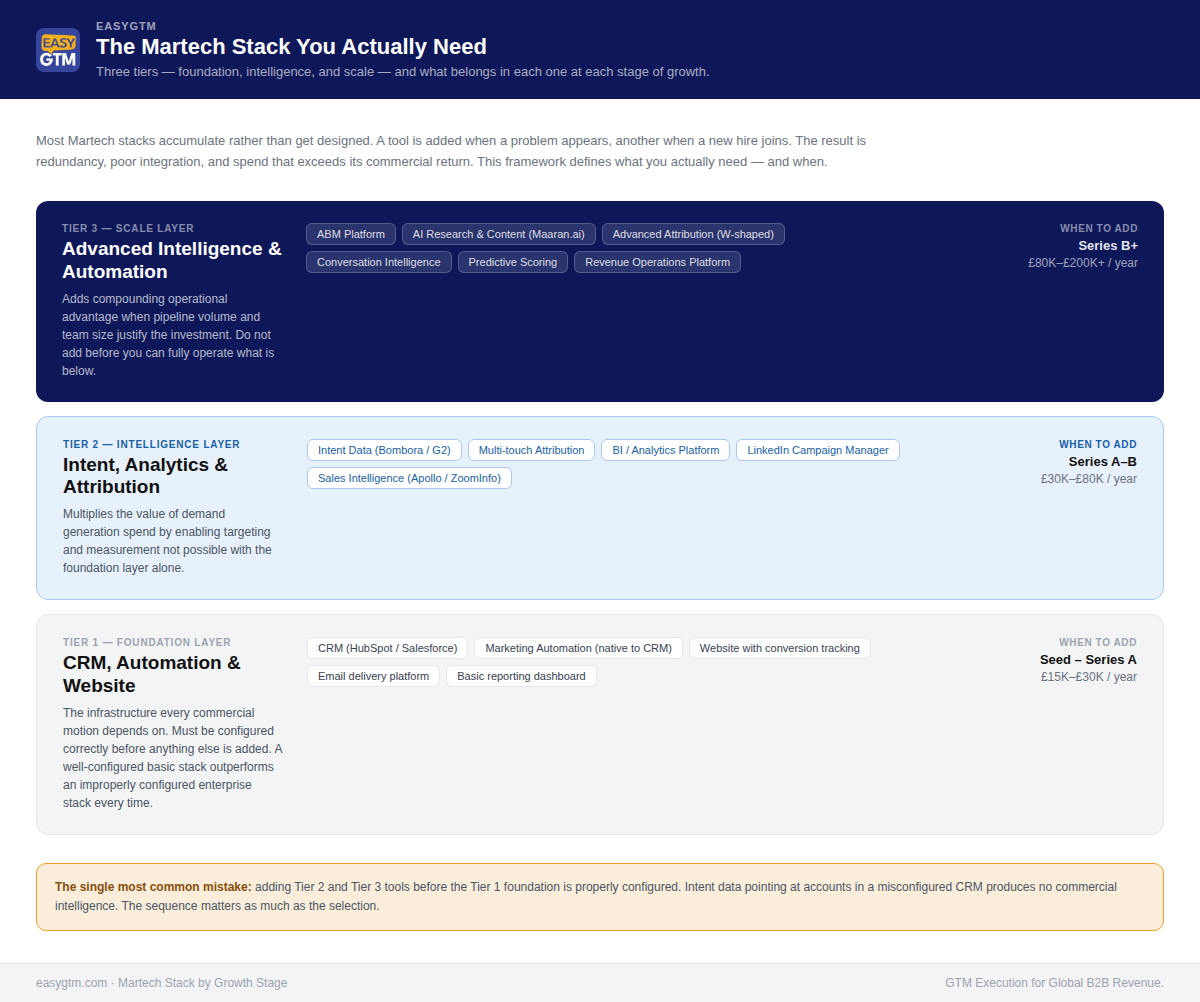
Martech decisions made under pressure — when a problem needs solving immediately, when a vendor’s offer is expiring, when a new hire wants the tools they used at their previous company — accumulate into stacks that cost more than they should and deliver less than they could. The average B2B company wastes between 20% and 35% of its Martech budget on tools that duplicate other tools’ functionality, tools that are not properly integrated, and tools that are used by fewer than two people on the team.
The framework below describes the stack that a B2B company actually needs at each stage of its growth, rather than the stack that vendors and advisors typically recommend.
The foundation stack (Seed to Series A)
The foundation stack has three components: a CRM, a marketing automation platform, and a website that is built on an architecture that allows tracking, personalisation, and attribution.
At this stage, the CRM needs to be configured correctly more than it needs to be sophisticated. A well-configured Hubspot or Salesforce instance will outperform an improperly configured enterprise CRM every time. The marketing automation platform should be native to or deeply integrated with the CRM — platform switching costs at a later stage are significant.
The foundation stack should cost between £15,000 and £30,000 per year at this stage, including all licenses and the configuration work required to make it operational.
The intelligence layer (Series A to B)
Once the foundation stack is generating consistent data, an intelligence layer makes that data actionable. This includes intent data to identify accounts showing buying signals, an analytics platform that moves beyond basic traffic reporting to user-level attribution, and the attribution infrastructure described elsewhere in these insights.
The intelligence layer multiplies the value of the demand generation spend by enabling targeting and measurement that are not possible with the foundation stack alone. It is the most significant efficiency improvement available to a Series A company without increasing its headcount or its campaign spend.
The scale layer (Series B and beyond)
An ABM platform, an AI-powered content and research tool, and a sophisticated attribution model become worth investing in when the pipeline volume and the team size required to operate them are in place. Adding ABM platform functionality to a company with a two-person marketing team and a limited account list produces cost without benefit. Adding it to a company with a 20-person commercial team and a target account list of 200 identified accounts produces measurable returns.
The scale layer is where Maaran.ai adds the most value: AI-powered account research, competitive intelligence synthesis, and content production at the volume a scale-stage demand generation programme requires.