Most international market entry decisions are made on a combination of strategic ambition and commercial pressure — a large market opportunity, an investor expectation, a competitor’s international announcement — rather than on a structured assessment of whether the company is ready to enter. The result is market entry that occurs before the conditions for success are in place, producing disappointing results that are attributed to the market rather than to the timing of entry.
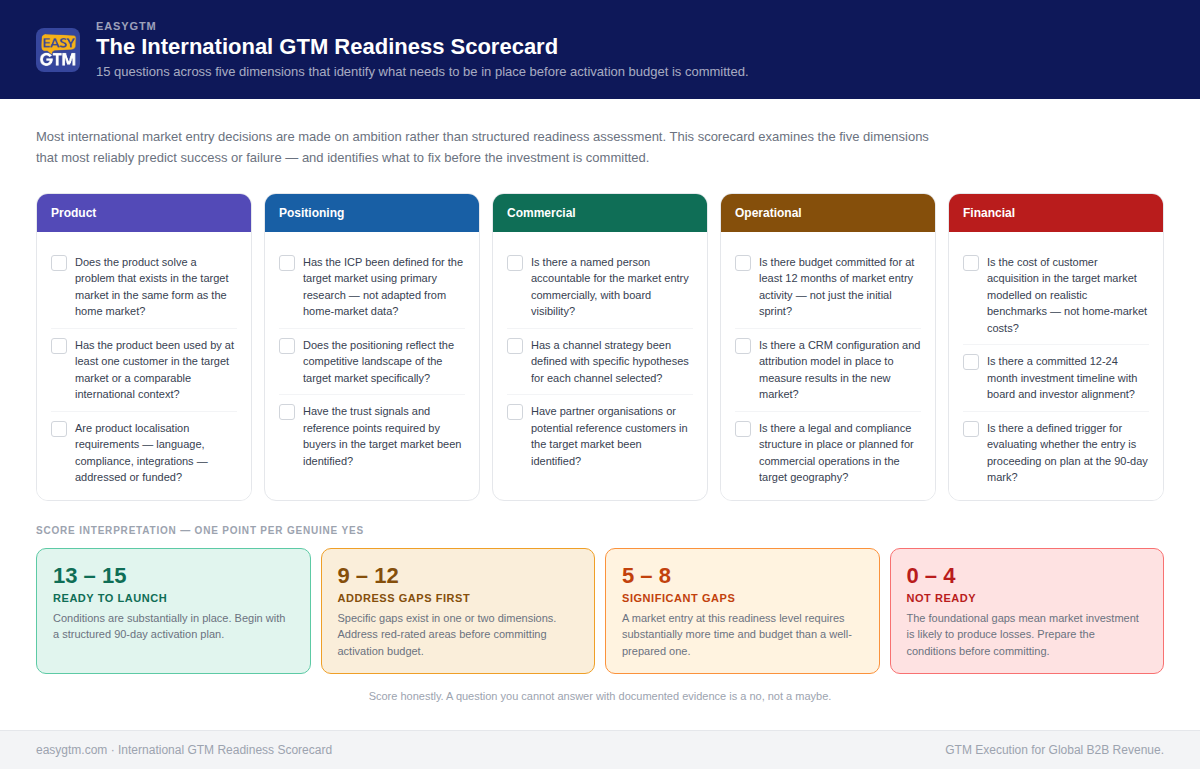
The readiness scorecard below assesses the five dimensions that most reliably predict success or failure in international GTM. It is not a reason to delay indefinitely. It is a tool for identifying what needs to be in place before the commitment is made.
Product readiness
Does the product solve a problem that exists in the target market in the same form it exists in the home market? Has the product been used by at least one customer in the target market or a comparable international market? Are there product localisation requirements — language, compliance, integration — that are addressed or have a funded plan?
Positioning readiness
Has the ICP been defined for the target market independently (not adapted from the home-market ICP without primary research)? Does the positioning reflect the competitive landscape of the target market, not the home market? Have the trust signals and reference points required by buyers in the target market been identified?
Commercial readiness
Is there a named person accountable for the market entry commercially? Has a channel strategy been defined with specific hypotheses for each channel? Are there identified partner organisations or potential reference customers in the target market?
Operational readiness
Is there a budget committed for at least 12 months of market entry activity? Is there a CRM configuration and attribution model in place to measure commercial results in the new market? Is there a legal and compliance structure in place or planned for operating commercially in the target geography?
Financial readiness
Is the cost of customer acquisition in the target market modelled based on realistic benchmarks rather than home-market costs? Is there a committed timeline of 12 to 24 months for the investment to produce returns, with board and investor alignment? Is there a defined trigger for evaluating whether the market entry is proceeding as planned?
Interpreting your score
13 to 15: High readiness. The conditions for successful market entry are substantially in place. Begin activation with a structured 90-day launch plan.
9 to 12: Moderate readiness. Specific gaps exist. Address the red-rated categories before committing activation budget.
5 to 8: Significant gaps. A market entry launched at this readiness level will require substantially more time and budget to produce returns than a well-prepared entry. Address the structural gaps first.
0 to 4: Not ready. The investment required to enter the market is likely to produce losses rather than returns until the foundational gaps are addressed. Prepare the conditions for entry before committing market budget.